Have you noticed how rare adda culture has become these days?
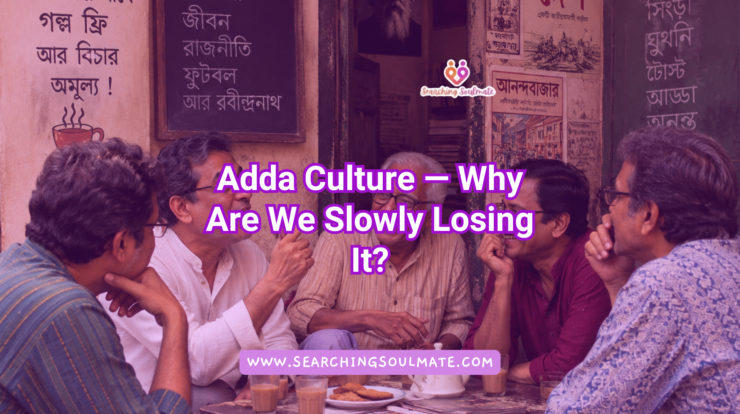
Not very long ago, an ordinary evening in Bengal looked very different. You would finish your work, step outside, and somehow end up spending hours talking to people. A cup of cha from the para’r dokan, a few friends standing near the mor, someone passionately discussing Mohun Bagan versus East Bengal, another debating whether Satyajit Ray’s films can ever be matched, and someone suddenly breaking into an old Kishore Kumar song. Before anyone realised, the streetlights were on, the tea had gone cold, and it was time to head home.
That was the beauty of adda culture. It didn’t need a WhatsApp group. It didn’t need a calendar invite. It didn’t need a purpose. It was simply people spending time together.
Today, however, something feels different. The para’r benches are emptier. The tea stalls are quieter. People are still talking, texting, posting, and reacting online, yet meaningful face-to-face conversations seem to be happening less often. And perhaps that is why so many people feel disconnected despite being constantly connected.
When Every Interaction Started Needing a Purpose
One of the biggest changes in modern life is that almost every interaction now has an objective attached to it.
We meet for work. We call to discuss something important. We attend events to network. Even social gatherings often revolve around plans, schedules, and responsibilities. Somewhere along the way, conversations became functional.
But adda culture was never functional.
Nobody gathered because they had something important to achieve. A discussion about cricket could suddenly become a debate about politics. A conversation about office life could lead to stories from school days. One random topic could take an entire evening and nobody would complain.
The conversation itself was the destination.
Perhaps that freedom is what many of us are missing today. We have become so focused on being productive that we sometimes forget the value of simply being present with people.
The Para Felt Like Family
What made adda culture truly special was not the conversation alone. It was the sense of belonging that came with it.
There was a time when most neighbourhoods felt like extended families. You knew who had just got a new job. You knew who was preparing for exams. You knew who had recently gone through heartbreak. You knew who needed support, even when they didn’t ask for it directly.
These connections were not built through grand gestures. They were built through hundreds of small conversations over months and years.
Today, many people know what their friends posted online but have little idea what they are actually feeling. We live closer than ever physically, yet many people feel emotionally distant.
Perhaps that is one of the biggest losses hidden within the decline of adda culture. We didn’t just lose conversations. We lost everyday spaces where people naturally cared for one another.
Every Adda Had Music Somewhere
It is almost impossible to think about adda culture without thinking about music.
Someone would always know a song. Someone would request another. A casual evening could suddenly turn into a mini musical session. Whether it was Kishore Kumar, Hemanta Mukhopadhyay, Manna Dey, Rabindra Sangeet, Rupam Islam, 80s English numbers, or a guitar appearing from nowhere, music always found its way into the adda.
The interesting thing is that music never felt like a performance.
It was simply part of being together.
One song would trigger a memory. That memory would spark a story. The story would lead to laughter. And suddenly everyone was participating in the conversation.
Perhaps that is why music remains one of the most powerful ways to connect people. It reminds us that some of the strongest human bonds are created not through information, but through shared emotions.
Maybe We Miss Adda Because We Miss Belonging
The more we think about it, the clearer it becomes that people do not miss adda culture simply because they miss talking.
They miss what adda made them feel.
The feeling of being welcomed without an appointment. The feeling of being known beyond your job title. The feeling of laughing without looking at the time. The feeling of being surrounded by people who were interested in who you were, not what you could offer.
Adda culture gave people a place where they didn’t have to constantly prove themselves.
Nobody cared how many followers you had. Nobody measured your worth through achievements or status. You simply showed up, joined the conversation, and became part of something bigger than yourself.
In a world where so many people feel pressured to perform, that kind of acceptance feels increasingly rare.
And perhaps that is why so many people feel nostalgic when they think about adda. What they are really missing is not the location or the tea stall.
They are missing the feeling of belonging.
Bringing Adda Culture Back in a Modern World
Life has changed, and perhaps adda culture will never look exactly the way it did twenty years ago. But that does not mean its spirit has to disappear.
People still want spaces where they can connect beyond work and responsibilities. They still want conversations that are not rushed. They still want opportunities to meet others who share their interests, stories, and experiences.
Maybe today’s adda happens through music gatherings, travel groups, hobby clubs, workshops, cultural events, or discussion circles. The format may evolve, but the need remains the same.
At its heart, adda culture was never about a location. It was about creating a space where people felt comfortable enough to be themselves, express their thoughts, share their stories, and feel heard.
Perhaps that is why platforms like Searching Soulmate are resonating with so many people today. Through hobby clubs, travel meet-ups, music sessions, workshops, cultural gatherings, and meaningful conversations, which are in adda formats many times,it is creating opportunities for people to experience something that feels increasingly rare in modern life—the joy of simply connecting without an agenda. Much like the addas many of us grew up with, these spaces bring together people from different walks of life to share experiences, exchange ideas, laugh together, and build genuine relationships.
Because maybe the real value of adda culture was never the tea, the bench, or the endless debates.
Maybe it was that your participation was valued, the feeling that no matter how busy life became, there was always a place where you could show up, be yourself, and know that you belonged.
And perhaps bringing back the adda culture starts with creating more of those judgment-free spaces again.
Read more from Searching Soulmate:
- Loneliness in a Relationship — The Silent Crisis We Rarely Admit
- Skincare and Self-Worth — When Beauty Becomes Personal
- Self-Worth and the Partners We Choose
Follow Our Socials: