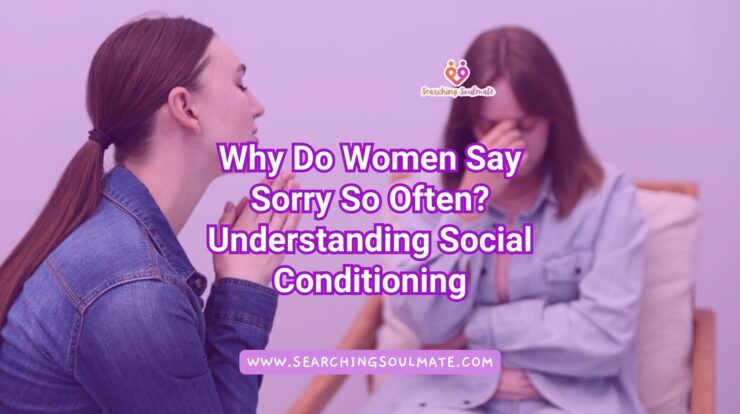
Have you ever noticed how women say sorry so often, sometimes even when they’ve done absolutely nothing wrong?
“Sorry, I was just asking…”
“Sorry, can I say something?”
“Sorry if I’m bothering you…”
And sometimes you just want to pause and say —
“Arre… sorry kis baat ka?”
It’s a small word. Just five letters. But when women say sorry so often, it reveals something deeper than politeness. It reflects years of subtle social conditioning that many of us grew up with without even realizing it.
Because somewhere along the way, many women learned that being “nice” often meant being a little apologetic.
And the strange part is — most of the time, nobody consciously teaches this. It simply becomes part of how girls learn to communicate with the world.
When Being Polite Slowly Turns Into Saying Sorry Too Often
For many women, the habit begins very early in life.
As children, girls are often encouraged to be polite, soft-spoken, understanding, and accommodating. These are beautiful qualities and they build empathy in relationships. But sometimes, hidden within these expectations is a subtle message — “Don’t be too difficult. Don’t be too demanding.”
Over time, the habit of adjusting quietly becomes normal.
A girl accidentally interrupts someone — she immediately says sorry.
She asks a question in class — she begins with “Sorry, I just wanted to ask something.”
She wants to express disagreement — and suddenly the sentence starts with “Sorry but…”
It becomes almost instinctive.
Not because she lacks confidence.
Not because she doubts herself.
But because the mind has slowly learned that saying sorry keeps situations comfortable.
It reduces friction. It avoids conflict. It maintains peace.
And many women grow up believing that maintaining peace is partly their responsibility.
The Small Everyday Moments Where It Shows Up
If you observe closely, you’ll notice that the pattern appears in the smallest everyday situations.
Imagine a meeting at work. A woman has an idea to share. Instead of directly saying it, she might start with something like, “Sorry, this might be a silly thought but…”
Or someone bumps into her while walking in a crowded space. Instinctively, she says, “Sorry.”
Even in casual conversations, women sometimes soften their opinions with apologies, as if expressing a thought itself needs permission.
Sometimes it almost feels like a Bollywood scene where the character quietly says, “Mujhe maaf kar do… shayad meri hi galti thi.”
Even when it clearly isn’t.
These apologies are rarely dramatic. They are soft, quick, almost invisible. But over time they become a communication pattern.
A pattern that many women themselves don’t even notice until someone points it out.
Why Society Quietly Encourages This Behavior
To understand why women say sorry so often, we need to look at the larger picture of social expectations.
For generations, women have been appreciated for being emotionally intelligent, understanding, and patient. They are often the ones expected to maintain harmony in families, workplaces, and relationships.
If an argument happens, the person who “adjusts” is often praised.
If someone compromises quietly, they are called mature.
And many women grow up observing this dynamic again and again.
So the habit of apologizing becomes less about guilt and more about emotional management. Saying sorry becomes a quick way to keep situations calm and avoid unnecessary tension.
In a way, it becomes a communication shortcut.
But the problem is — when apologies become automatic, they sometimes start replacing honest expression.
The Moment Many Women Begin To Notice It
Interestingly, many women only realize this pattern later in life.
It might happen in a workplace conversation, during personal reflection, or when someone gently asks, “Why are you apologizing?”
That small question can feel surprising.
Because suddenly a thought appears: “Wait… was this actually my fault?”
And slowly, awareness begins.
A woman notices how often she says sorry before speaking. She notices how often she apologizes just for asking a question. And that realization can be both strange and empowering.
Because confidence does not always come through loud declarations.
Sometimes confidence begins quietly, when a person decides to pause before apologizing.
Replacing Apologies With Honest Expression
This conversation is not about telling women to stop being polite. Politeness and empathy are important in any relationship.
But there is a difference between politeness and unnecessary apology.
Instead of saying “Sorry for asking,” someone might simply say, “I have a question.”
Instead of “Sorry if this sounds wrong,” it might become “Here’s what I think.”
The tone remains respectful. The communication remains kind.
But the apology disappears.
And that small shift changes something internally.
Because every time someone expresses themselves without apologizing for existing, they slowly reclaim their voice.
The Real Change Begins With Awareness
Understanding why women say sorry so often is not about blaming individuals. It’s about recognizing the quiet ways society shapes communication patterns.
When we become aware of these patterns, we begin to see them everywhere — in conversations, workplaces, friendships, even in family dynamics.
And once awareness enters the picture, change becomes possible.
Women start noticing when apologies are unnecessary.
Conversations start becoming more direct.
Confidence begins growing naturally.
Because respect and connection do not come from constantly apologizing.
They come from being able to speak honestly while still being kind.
Maybe The Real Question Is This
Instead of asking why women say sorry so often, maybe we should ask a deeper question.
Are we creating spaces where women feel comfortable expressing themselves without needing to soften their voice first?
Because confidence does not grow in environments where people feel they must constantly shrink themselves.
It grows in places where thoughts are welcomed, opinions are respected, and voices are heard without judgment.
And sometimes the most powerful shift begins with a very small realization.
Not every sentence needs to begin with “sorry.”
Sometimes it just needs to begin with a voice that feels safe enough to speak.
Read more from Searching Soulmate:
- The Power of Female Friendship- Why Your Girlfriends Are Your Secret Weapon for a Happy Life
- Personal Transformation Stories: Women Who Walked Away:From Breakdown to Breakthrough
- Loneliness in a Relationship — The Silent Crisis We Rarely Admit
Follow Our Socials: