Have you ever walked through a busy street, surrounded by faces, and felt… alone?
Welcome to the paradox of urban life: cities are packed with people, but real connection feels elusive.
We used to belong to places — not just people.
Now we belong to routines, screens, and curated circles of choice.
This isn’t nostalgia talking. It’s a lived experience many urban Indians born prior to 2000 silently carry.
Why Adult Belonging Feels Different
Ask anyone in their 30s or early 40s: the way you made friends in school or college feels nothing like how you make friends now.
As kids, belonging wasn’t a project. It was a given.
- Your neighborhood was your village.
- Your classmates were your everyday companions.
- Shared routines meant shared emotional experiences.
College? A ready-made community where identity, rituals, and friendships were almost automatic.
Now? You juggle work, responsibilities, family visits, personal growth… and still feel like something is missing.
Why?
Because adult belonging isn’t handed to you.
It has to be chosen.
With intention.
And that’s a very different emotional process from childhood friendship.
Digital Connection Isn’t the Same as Emotional Belonging
We’re hyper-connected. WhatsApp groups. Instagram posts. Reactions. Heart emojis.
But digital interaction doesn’t equal emotional proximity.
There’s an Indian saying: “Bina baat ke rishta nahi chalne ka.”
Relationships don’t run without conversation.
And shortening conversations into emojis and stories doesn’t fill the gap — it just covers it up.
People can have 500 contacts and still struggle to find one person they can sit with in silence — and feel understood.
Traditional Communities Offered Something Automatic
Let’s rewind — not too far — to when communities were defined by geography, family, and daily shared rituals.
What traditional communities did:
Built-in identity — You knew who you were by virtue of where you belonged.
Predictable support — Someone always checked in, physically and emotionally.
Shared rituals — Festivals, pujas, evening walks, chai corners — they were routines that held people together.
In the early days, you’d know your neighbor and your colleagues quite well by being part of their celebrations,daily mundane chit chat & also standing by troubled times.
In small towns, birthdays were community affairs, not curated events.
You didn’t search for belonging. You lived it.
Today’s Reality: Migration and the Loss of Belonging Structures
Urban migration, nuclear families, and career priorities have reshaped how we exist socially.
People move cities faster than they grow roots.
Families used to be multi-generational living systems — now, they’re only part of WhatsApp groups..
Support systems are informal — until they aren’t.
Safety nets become intangible.
A 2023 survey by the Pew Research Center found that loneliness and social isolation are rising globally, especially in urban populations, even among those with heavy digital connectivity — suggesting that connection frequency is not the same as emotional belonging. (Source: Pew Research Center, 2023)
That echoes what many of us feel but rarely say out loud.
Belonging Isn’t Automatic — It Must Be Created
This is why adult belonging in urban setup often takes shape in circles — intentional, chosen, and emotionally curated groups.
Here’s how circles differ from traditional communities:
Choice over geography: You choose who you show up with.
Values over rituals: Belonging becomes about shared meaning, not proximity.
Conversations over routines: Deep talk replaces daily routines as bonding mechanisms.
It’s less “everyone knows you” and more “you’re known by people who see you & don’t judge you.”
Why Intentional Spaces Matter Now More Than Ever
Spaces designed for depth — not just attendance — help bridge the adult belonging gap.
That’s where communities like Searching Soulmate come in. Not as replacements for family or childhood friendships, but as intentional circles — spaces where people choose connection, show up willingly, and make room for honest conversation.
Through purposeful discussions, hobby-led gatherings, live sessions, and workshops that focus on the individual rather than profession or status, people reconnect with something often missing in urban life: the permission to slow down and be real. When people make space for themselves, connection follows naturally.
Belonging used to be automatic.
Now, it is intentional.
And maybe that’s not a loss — but an evolution. A shift from simply living near people to sharing life with those who understand us.
Because adult belonging isn’t about the number of faces around you.
It’s about the quality of presence between you.
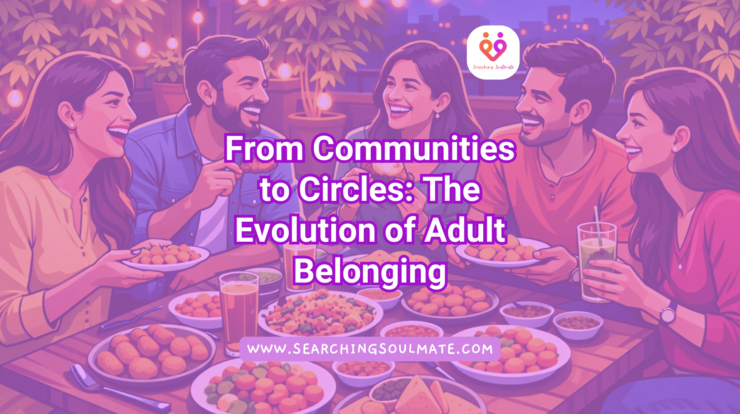
This is also why experiences rooted in food and conversation matter today. At Searching Soulmate, the thinking behind a gathering like Memory on Plate, an initiative to connect stories & lives through shared love for food goes beyond what’s served on the table. Food becomes a familiar entry point — a gentle way to slow down, sit together, and talk without rushing.
Such spaces echo what traditional communities once offered naturally: shared moments, unfiltered conversations, and the comfort of being heard. In a world where belonging no longer comes built-in, these intentional experiences help form circles that feel safe, grounded, and emotionally real.
Belonging doesn’t have to come from where you live or who you’re related to.
Sometimes, it grows when people are given time, attention — and a shared table where they’re free to simply be themselves beyond the professional facade or the responsibilities society has drawn.
Read more from Searching Soulmate:
- Community Matters: 3 Keys to Happiness and Health
- Kindness vs. Pleasing People: How to Know the Difference
- How Events Like Christmas Socials Help Urban Indians Find Their People
Follow Our Socials: