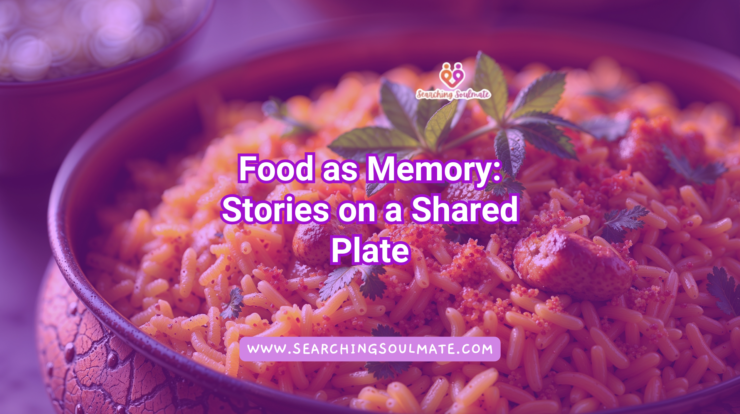
Some memories don’t arrive with photographs.
They come back quietly — through smell, taste, or the sound of a spoon scraping the bottom of a steel bowl.
You might forget dates, faces, even conversations.
But you will remember how that dal tasted at your grandmother’s house.
Or how the tea felt different during a late-night conversation with someone who mattered.
That’s because food as memory doesn’t live in the brain alone.
It lives in the body.
Research shows that eating together triggers our brain’s bonding chemistry. Shared meals stimulate the release of oxytocin and dopamine, the same neurochemicals linked to trust and pleasure, which strengthen social bonds and emotional connection. This helps explain why meals shared with loved ones often become the most lasting memories.
Why Food Holds On When Everything Else Fades
Think about it.
When life moves forward, food often stays behind — waiting.
A study published in Frontiers in Psychology explains that smell and taste are directly linked to the brain’s emotional memory centers, which is why food memories are often more vivid and emotional than visual ones.
But science only explains how.
It doesn’t explain why it hurts and heals at the same time.
Food remembers moments we didn’t know were important when they happened.
According to the 2025 World Happiness Report, people who share more meals with others report higher overall well-being — comparable to other major life factors such as income and employment — highlighting that communal eating isn’t just tradition, it’s essential to emotional health.
A rushed lunch before an exam.
A shared plate during a difficult conversation.
That last meal before someone moved away.
The Stories We Don’t Tell — But Still Eat
In many Indian homes, recipes were never written down.
They were passed through gestures.
“Thoda sa aur.”
“Ab bas.”
“Ismein patience lagta hai.”
Food carried unspoken emotions — love, sacrifice, worry, hope.
You might not remember what your parents said every day.
But you remember what they cooked when things were hard or happy or festive.
That’s the thing about food.
It shows up even when words don’t.
Shared meals have been linked to lower stress and better mental balance. Studies show that regular communal eating is associated with reduced loneliness, improved emotional support, and stronger social cohesion. People who eat with others tend to form deeper interpersonal bonds and have higher levels of trust — illustrating that meals are as much about connection as they are about nourishment.
Why Eating Together Feels Different Than Eating Alone
We eat alone often now.
At desks. In cars. With phones beside our plates.
Yet something changes when food is shared.
Silences soften.
Conversations slow down.
People listen differently.
You don’t need deep talk every time — sometimes just passing a dish creates connection.
Psychologists call this communal eating — when shared meals build trust and emotional safety without effort.
We call it feeling at home.
When Memory Becomes the Main Ingredient
At Searching Soulmate, we created a Food Club to turn food into a bridge between strangers, and meals into moments of connection.This understanding shaped one of our past community experiences — a food-focused gathering where people came together because food is the easiest way to begin a conversation of the heart.
There was no pressure to perform.
Just plates, stories, pauses, and laughter that came naturally.
People spoke about dishes tied to loss.
Others spoke about comfort foods from childhood.
Some just listened — and that was enough.
The event ended.
But the feeling didn’t.
That’s how food works.
It leaves a trace long after the table is cleared.
Why We Crave These Moments More Than We Admit
Urban life teaches efficiency, not nourishment.
We schedule meetings easily.
But struggle to schedule connection.
Food, when shared intentionally, becomes a reason to slow down without explanation.
You don’t need a topic.
The plate does the talking.
And in spaces like Searching Soulmate, food becomes more than eating — it becomes a bridge between strangers, memories, and emotions we rarely name.
What Your Food Memories Are Trying to Tell You
Next time a smell stops you mid-step, ask yourself:
Who was I with the last time I ate this?
What version of me existed then?
What did I feel safe enough to forget?
Because food as memory isn’t about nostalgia.
It’s about continuity.
About knowing that even as life changes, some parts of us remain intact — waiting at the table.
And sometimes, all it takes to reconnect is sitting down, sharing a plate, and letting memory do what it has always done best —
Bring people back to themselves.
Read more from Searching Soulmate:
- From Communities to Circles: The Evolution of Adult Belonging
- Why Small Talk Exhausts Urban Adults — and What We Actually Crave
- Kindness vs. Pleasing People: How to Know the Difference
Follow Our Socials: